From Estimation to Execution: Kanban in ScopeWise
At ScopeWise, we have always focused on one mission: helping teams move faster without losing clarity. First, our initial feature was to generate estimates. Then we streamlined quote and document generation. Today, we are extending that same logic to execution with our new Kanban board feature. Why? Because many IT teams still face the same daily problem: great plans are created at kickoff, but progress becomes hard to track once delivery starts. Information gets scattered, priorities change every day, and small blockers can delay major milestones. A modern team needs one shared visual system to keep everyone aligned.
Our Kanban board is designed for Product Managers, Product Owners, tech leads, agencies, and freelancers who want a practical workflow they can adopt immediately. It is simple on purpose, but powerful enough to manage real delivery constraints: dependencies, team capacity, changing priorities, and stakeholder visibility. In this article, we explain what a Kanban board is, why it is so effective in IT projects, and how it differs from Scrum so you can choose the best approach for your context.
What is a Kanban board?
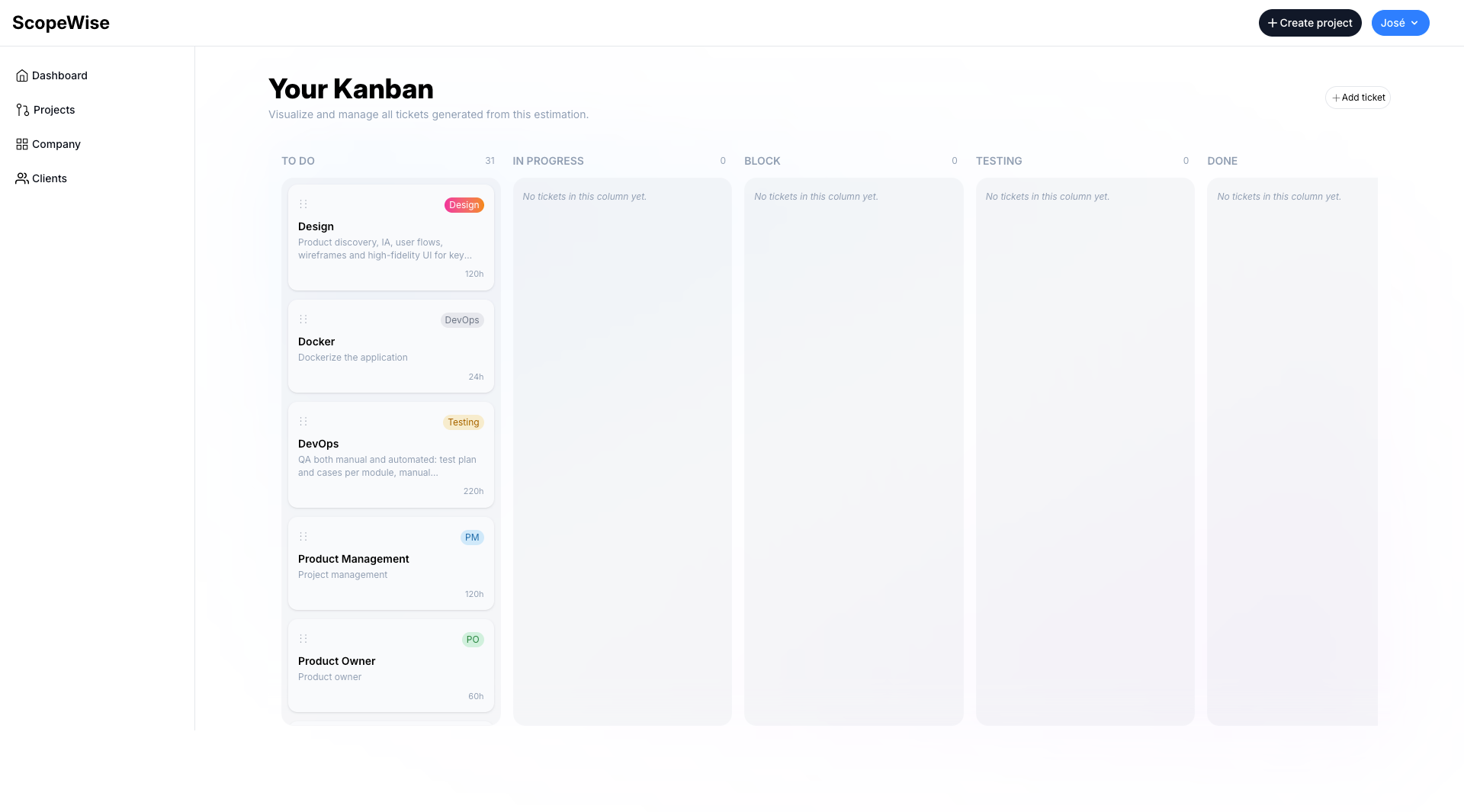
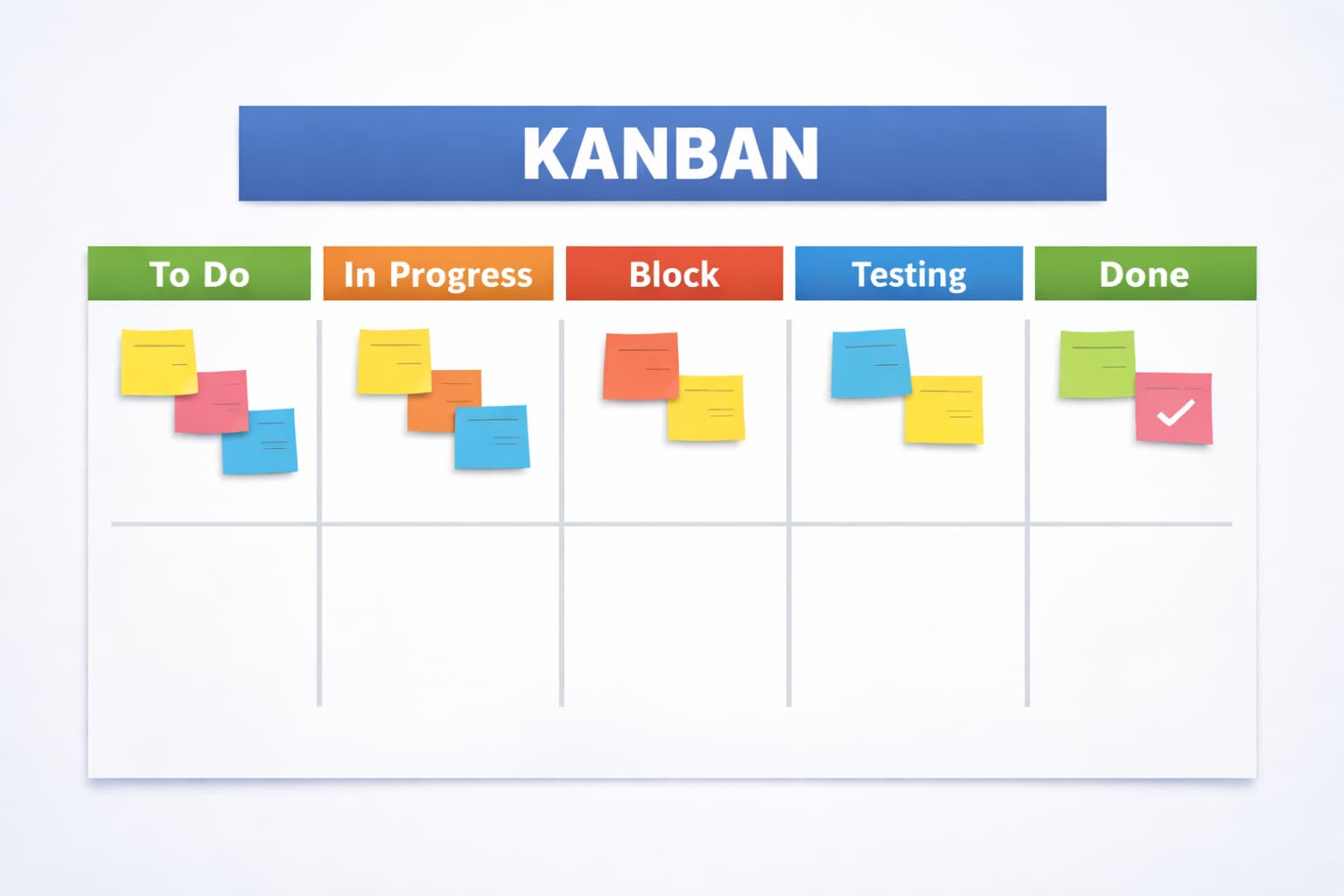
A Kanban board is a visual management system used to represent work as it moves through a process. In its simplest form, work is organized into columns such as To Do, In Progress,Block, Testing, and Done. Each task is a card. As work advances, the card moves from left to right. This gives every team member and stakeholder an immediate understanding of current status without opening multiple tools or spreadsheets.
Kanban originated in manufacturing and was later adopted by software teams because it solves a universal operational challenge: making flow visible. In many projects, delays are not caused by lack of effort, but by invisible bottlenecks. Maybe too many tasks are started at once. Maybe reviews wait too long. Maybe QA becomes overloaded at the end of the sprint. With Kanban, these bottlenecks become obvious because work accumulates in specific columns.
Another core principle of Kanban is limiting work in progress (WIP). Instead of starting 20 tasks and finishing none, teams set practical limits per stage and focus on finishing before starting new work. This encourages better throughput, better predictability, and less context switching. For IT teams, this is critical: developers, designers, and product people perform better when priorities are stable and active work is controlled.
A Kanban board is therefore not just a visual list of tasks. It is a decision framework. It helps teams answer simple but essential questions every day: What should we do now? What is blocked? Where is the delivery risk? What can we finish this week? The board turns abstract planning into concrete execution behavior.
What is Kanban used for?
Kanban is used to improve operational flow and delivery reliability. In real project life, priorities change, new requests appear, and technical complexity evolves. A rigid plan often breaks under this reality. Kanban offers a more adaptive way to manage work continuously, while still maintaining control and visibility.
For Product Managers and Product Owners, Kanban provides a live map of execution. Instead of waiting for a status meeting, they can instantly see where value is moving and where it is stuck. This helps them reprioritize quickly, negotiate scope intelligently, and communicate realistic timelines to stakeholders. It also improves trust because the project state is transparent, not hidden in private notes or disconnected tools.
For development teams, Kanban clarifies focus. Everyone knows which task should be pulled next and what completion means at each stage. With explicit stages like In Progress, Code Review, QA, and Done, handoffs become cleaner. Teams can also track cycle time (how long a task takes from start to finish) and use it to forecast more accurately over time.
For agencies and freelancers, Kanban improves client communication. Clients often ask: What is done? What is next? Are we on track? A board answers these questions visually and objectively. This reduces friction and avoids long explanation threads. It also helps align billing, milestones, and delivery commitments with real progress.
Inside ScopeWise, the value is even stronger because Kanban is connected to project scoping. You can move from estimate to execution in one consistent workflow. Instead of rebuilding task structures in another platform, teams keep project context, priorities, and outcomes aligned. This continuity reduces operational waste and speeds up the transition from planning to shipping.
In short, Kanban is used to deliver faster with less chaos. It is especially effective when your team needs flexibility, frequent reprioritization, and clear day-to-day coordination.
Kanban vs Scrum: what is the difference?
Kanban and Scrum are both Agile approaches, but they are built on different execution models. Scrum is time-boxed. Work is planned in fixed sprints (often two weeks), and teams commit to a set of items for that sprint. Scrum includes defined roles and ceremonies: Product Owner, Scrum Master, Sprint Planning, Daily Scrum, Review, and Retrospective.
Kanban is flow-based. There are no mandatory sprints, no required role structure, and no fixed ceremony framework. Work is pulled continuously according to team capacity. The focus is on optimizing flow efficiency, reducing wait states, and improving throughput over time.
This difference has practical consequences. Scrum can be very effective when teams need strong planning cadence, stable sprint commitments, and structured rituals. It is often a good fit for organizations that benefit from fixed planning cycles and clear sprint reviews.
Kanban is often better when incoming priorities are dynamic, support work and delivery work are mixed, or teams need to react quickly without waiting for the next sprint boundary. If your environment changes daily, Kanban usually provides more operational flexibility.
It is also important to note that this is not always an either-or decision. Many teams use a hybrid model: Scrum for high-level planning rhythm and Kanban for visual flow control between ceremonies. For example, a team may still run biweekly planning but manage day-to-day execution with WIP limits and a continuous Kanban board.
At ScopeWise, we designed the Kanban feature to support practical delivery, not dogma. Whether your team is Scrum-first, Kanban-first, or hybrid, the board gives you the visibility and control required to execute effectively. What matters most is not methodology purity, but your ability to ship value consistently.
The new Kanban board in ScopeWise closes an important gap between planning and delivery. You can estimate, document, prioritize, execute, and communicate progress in one coherent system. If your team wants less tool fragmentation, better execution visibility, and faster delivery decisions, Kanban is a strong next step. And with ScopeWise, you can adopt it immediately while preserving the project context you already built.
Want to scope your next project faster?
Turn ideas into estimates, documents, and delivery-ready plans in one workspace.