What Does Being a Project Manager Look Like in 2026?
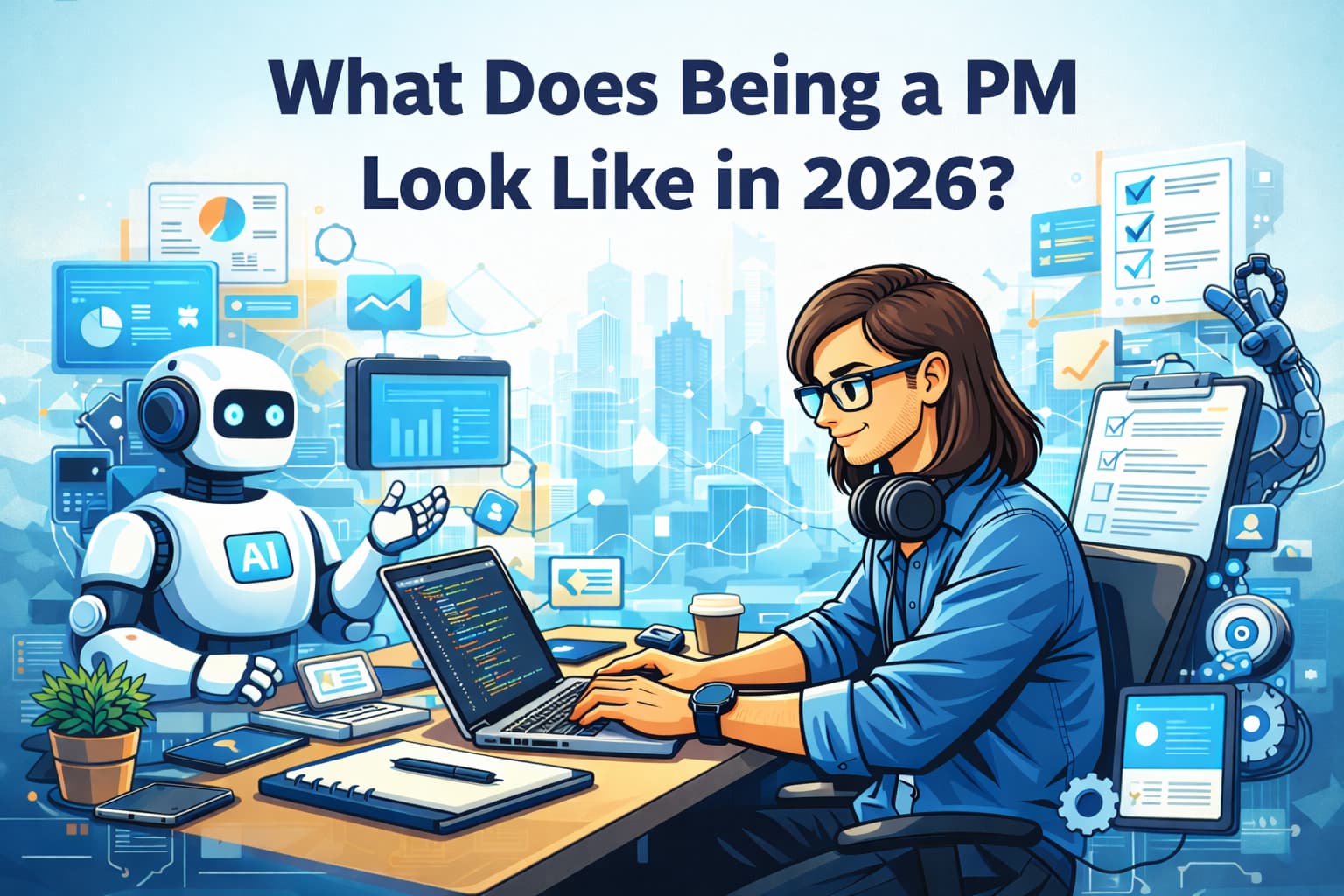
Product Management in 2026: From Coordination to Creation
The Product Manager role has never been more visible, and never more transformed. For years, PMs were taught to orchestrate: align teams, prioritize backlogs, shape roadmaps, clarify user needs, and drive trade-offs. That foundation still matters. But in 2026, it is not enough on its own. Delivery cycles are shorter, experimentation loops are faster, and AI has moved the line between planning and building.
With tools like Claude available today, PMs need to be technically curious by default: comfortable reading technical context, understanding architecture at a practical level, using AI build tools, collaborating directly in repositories, and sometimes producing executable prototypes themselves. In many product teams, a PM can now test an idea the same day it is conceived.
This changes the credibility model. A PM who arrives with only a polished deck and abstract requirements slows execution. A PM who arrives with a clear hypothesis, a scoped prototype, measurable success criteria, and implementation-ready context accelerates the entire system. In 2026, PM impact is measured less by documentation volume and more by the ability to reduce the distance between product intent and shipped outcomes.
This trend is practical, not theoretical. You have to tinker, try, and iterate to understand what is changing. Development is no longer a black box between specification and release. It is an iterative conversation between people and agents. In that environment, PMs who avoid technical depth are increasingly limited. PMs who engage with technical execution become force multipliers.
Why PMs Must Be Technical in 2026
Being technical in 2026 does not mean shipping features from 0 to 1 every week. It means mastering a practical operating set:
1. Turning ambiguous business needs into clear constraints.
2. Understanding what is fast to build, what is safe to scale, and what is expensive to maintain.
3. Writing specifications that both humans and AI systems can execute reliably.
4. Reviewing generated output for quality, risk, edge cases, and maintainability.
5. Partnering with engineering as a build ally, not just a requester.
Engineering expectations have also changed. Historically, friction between product and engineering often came from vague requirements or unstable priorities. With AI acceleration, this friction must decrease or disappear altogether as both sides need to be more easily aligned. So being technical will enable the PM to make more realistic requests to the engineering team.
PMs Can Get Their Hands Dirty
This is no longer controversial in high-velocity teams: many PMs are actively building. Not full production platforms alone, but MVPs, scoped internal tools, limited user flows, and testable prototypes connected to real usage signals.
Why now? Because the toolchain changed:
- AI-augmented editors
- Repository-aware coding agents
- Automated test generation support
- Multi-model review passes
A PM can start from a user problem, create an implementation brief, generate a first version, review it with AI and teammates, have it tested by 50 users and hand off for engineering hardening if it's relevant. Engineering ownership does not disappear. It becomes focused on architecture, security, reliability, and long-term maintainability, while PMs contribute more directly to early execution.
There are now public examples of PMs shipping practical prototypes with limited traditional coding backgrounds by using AI workflows effectively. This is not about replacing engineers. It is about changing who can contribute to product execution and at what speed.
In the near future, the boundary may move further. As intent-driven development matures, PMs who can define behavior, constraints, and validation criteria may be able to deliver complete scoped features in collaboration with AI and engineering review. This is already emerging in some teams for lower-risk surfaces and internal tooling.
However, a high-performing PM builder is not a solo hero. They are an accelerator inside a disciplined engineering system.
Technical Access + Classical PM Skills = Product Superpowers
PMs already carry rare strengths: product vision, user empathy, prioritization discipline, data analysis, problem framing, stakeholder communication, and strategic trade-off management. When those strengths are disconnected from execution, impact depends on relays and handoffs. When they connect directly to build workflows, PM leverage increases dramatically.
The old pattern was often slow: requirement writing, sprint scheduling, implementation queue, delayed signal. In 2026, a PM can define a narrow experiment, prototype quickly, instrument key events, and make a ship-or-kill decision within days instead of weeks. Decision quality improves because evidence arrives faster and closer to the original question.
Specification quality also improves when PMs work closer to implementation. Requirements become explicit enough to execute, acceptance criteria become testable, dependencies are visible earlier, and ambiguity is surfaced before expensive development cycles begin.
Trade-off quality improves too. PMs with technical literacy negotiate better with business and engineering because they understand system cost, delivery risk, and maintenance implications. They know when to push for speed and when to invest in stability.
Collaboration quality rises as well. The classic product-versus-engineering conflict often decreases when PMs speak the language of constraints. PMs do not need to outcode engineers. They need to co-design delivery conditions that make good engineering easier.
Leadership quality becomes more concrete. A PM who can connect narrative and execution builds trust with stakeholders: not only “here is the strategy,” but “here is what we tested, what we learned, and what we should ship next.”
In 2026, this combination is increasingly decisive:
Product vision + technical literacy + AI-assisted execution = outsized impact 💪
Tomorrow, All PMs?
The question sounds provocative, but it points to a structural shift. If AI continues reducing the cost of software production, who becomes responsible for build outcomes? Only engineers? Only PMs? Most likely neither. The direction points toward hybrid product teams with more fluid role boundaries.
A widely discussed signal came from Spotify in early 2026. During its Q4 2025 earnings communication, Spotify leadership described senior engineers generating and supervising code rather than manually writing every line. This is not the end of engineering. It is a shift from manual implementation as the core task to supervision, architecture, validation, and systems thinking as the core task.
If that pattern expands, PM workflows change too. Teams are moving from “ticket to implementation” toward “intent to executable specification to supervised generation.” In that model, the quality of intent becomes a first-order variable. PMs are often the owners of that intent.
This is why many teams now add user stories and feature definitions in the repository project in a Markdown file (eg: agent.md), implementation notes, and machine-readable acceptance criteria that can be read by the AI-powered editor. With ScopeWise, you can generate the file from your estimate and download it if necessary.
So does “Tomorrow, all PMs?” mean everyone gets a PM title? No. It means PM-like capabilities are spreading across roles, while engineering-like execution access is spreading beyond traditional engineering boundaries.
In practice:
- Engineers increasingly contribute to product reasoning.
- PMs increasingly contribute to technical execution.
- Designers increasingly prototype functional experiences.
- Teams that learn cross-functionally move faster with higher quality.
The strategic question for PMs is not: “Should I code like a full-time engineer?”
The strategic question is: “Can I convert product intent into reliable shipped outcomes, end to end, with the right technical and quality guardrails?”
If the answer is yes, PM relevance does not decline in 2026. It compounds.
Conclusion
The Product Manager of 2026 is neither a backlog administrator nor an engineer replacement. They are a value operator who can move between strategy, discovery, data, execution, and technical decision-making with precision.
AI accelerates every stage of product development: ideation, prototyping, implementation, and iteration. But AI does not choose the right problem, define acceptable quality, or own the trade-off between speed and durability. Human judgment is still central, and PMs remain key carriers of that judgment.
The PMs who will outperform in 2026 make three practical commitments:
1. A commitment to technical fluency: enough depth to build better decisions.
2. A commitment to execution rigor: turning intent into testable, executable artifacts.
3. A commitment to continuous learning: shipping faster without sacrificing product quality.
This is not a temporary trend. It is a structural evolution of product work. For PMs willing to embrace it, 2026 may be the most powerful moment yet to shape products, teams, and outcomes.
Sources
- Spotify Investors Events (Q4 2025 materials): https://investors.spotify.com/events/default.aspx
- Spotify Q4 2025 Shareholder Deck (February 10, 2026): https://s29.q4cdn.com/175625835/files/doc_financials/2025/q4/Q4-2025-Shareholder-Deck-FINAL.pdf
- Earnings call transcript reference: https://www.fool.com/earnings/call-transcripts/2026/02/10/spotify-spot-q4-2025-earnings-call-transcript/
- TechCrunch coverage of Spotify AI workflow discussion: https://techcrunch.com/2026/02/12/spotify-says-its-best-developers-havent-written-a-line-of-code-since-december-thanks-to-ai/
- GitHub Octoverse 2024 (GenAI contribution trend): https://github.blog/news-insights/octoverse/octoverse-2024/
- Business Insider example of PM AI-assisted building workflows: https://www.businessinsider.com/meta-product-manager-vibe-coding-superpowers-non-technical-builder-2026-1
Inference note: sections on role convergence and repository-native spec workflows describe directional patterns inferred from current signals, not universal practice in every company.
- Reddit: SubReddit Product Management :https://www.reddit.com/r/ProductManagement
Hi 👋 I'm Tanguy, the founder of ScopeWise. Feel free to reach me if you want to exchange on Linkedin or on X.
Want to scope your next project faster?
Turn ideas into estimates, documents, and delivery-ready plans in one workspace.